
Your ideas probably feel fragile right now. You post, you refresh, you stare at the little heart icon like it owes you money. Nothing.
Crickets so loud you can hear your own self-doubt picking up a megaphone. Here’s the truth: your ideas might be great, and the algorithm just didn’t RSVP yet. Let’s talk about trusting your creative brain when the numbers don’t show up.
Stop Worshipping the Like Button

We treat likes like oxygen, but they’re more like confetti: fun, not essential. Engagement is a lagging indicator, not a moral judgment on your talent.
Sometimes your audience needs time to find you. Sometimes the platform buries your post like it’s in witness protection. So what do you trust instead? Signal over noise:
- Did you say something new or useful?
- Did you enjoy making it?
- Would a specific person benefit—even if most people scroll past?
If you can answer yes to two of those, you’re onto something.
Keep going.
Define Your Own Scoreboard
If your only metric is likes, you lose early. Create a scoreboard you control:
- Consistency: Did you ship 3 times this week?
- Craft: Did you clarify your hook, tighten your story, or test a new format?
- Connection: Did one human DM you or reply thoughtfully?
- Learning: Did you try one small experiment and log the result?
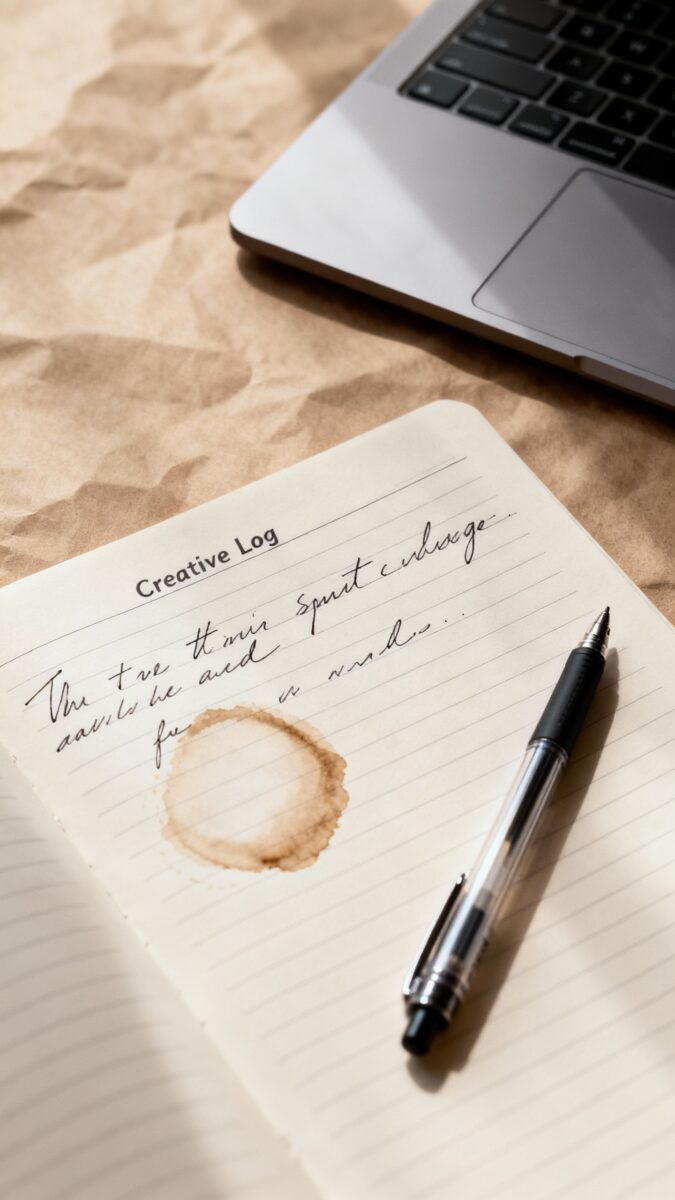
When you track progress you can directly influence, you reduce the anxiety tax. IMO, the most underrated flex is a well-kept creative log.
Build a tiny feedback loop
Make a simple doc where you track:
- Topic
- Format (carousel, short video, thread, long post)
- Hook used
- One thing you tested
- What you’ll do differently next time
That’s it.
Five minutes. Over 30 posts, patterns will shout at you.
Get Uncomfortably Specific
General ideas rarely hit because they read like oatmeal. Good, safe, bland. Specific beats smart every time.
Don’t write “how to be productive.” Write “how I answer email in 12 minutes using 3 canned responses.” Now we’re cooking.
Sharpen your premise
Ask yourself:
- What’s the one sentence promise?
- Who is this specifically for?
- What problem does it solve this week, not someday?
If you can’t answer those, your idea isn’t wrong—it’s fuzzy. Clarity invites attention.
Separate Idea Quality from Execution Quality
Many “bad” posts hide good ideas under weak packaging. Don’t throw out the cake because the frosting slid.
Fix the wrapper. Here’s a simple execution audit:
- Hook: Does your first line make a promise or provoke curiosity?
- Structure: Are your paragraphs short and scannable?
- Proof: Do you include one story, example, or number?
- CTA: Do you ask for a reply, share, or a simple next step?
Redo an old “flop” with these four checks. Often it wasn’t the idea—it was the delivery.
FYI, most creators repost high-performing ideas 3–5 times with tweaks.

Borrow Perspective from Future-You
You’re not just making content. You’re building taste and stamina. Future-you will be annoyingly grateful you kept going. When you want to quit, ask: “If I make 100 iterations of this idea, how good will I be?” That question moves you from panic to patience.
The 100-Rep Rule
Commit to 100 reps of one idea style:
- 100 short videos answering niche questions
- 100 carousels breaking down tools or frameworks
- 100 emails telling one story with one lesson
By rep 30, you’ll spot patterns.
By rep 60, you’ll grow instincts. By rep 100, people will call you “lucky.” Cute.
Test in Small Rooms Before Big Ones
You don’t need a viral audience. You need 10 honest people.
Share drafts in DMs, small communities, or with colleagues who understand your space. Ask for specific feedback: “Where did you get bored?” beats “What do you think?”
Use this feedback script
Send this message:
- “I’m testing a 60-second version of an idea. Could you read/watch and tell me: 1) where you’d stop, 2) what’s unclear, 3) what you’d want next?”
No fluff.
You’ll get one actionable tweak every time.
Protect Your Voice Like It’s Your Wi‑Fi Password
Algorithms tempt you to sound like everyone else. Don’t. Your weird quirks are your moat—the phrases you overuse, the stories you tell, the obsessions you can’t shut up about. People follow voices, not templates.
How do you find that voice?
- Write or record fast for 10 minutes. Don’t edit. Circle the lines that sound like you.
- Create a “spice rack”: 5 repeatable formats you love (mini-rants, teardown, before/after, quick wins, myth-busting).
- Adopt one signature—an opening line, a recurring bit, a visual cue.
Yes, it’s risky.
Yes, it’s worth it. Vanilla doesn’t get remembered.
Make Peace with Quiet Seasons
Sometimes your best work gets ignored because your timing is off, not your idea. Audiences ebb and flow. Quiet doesn’t equal wrong.
Use silent weeks to tighten fundamentals:
- Refresh old posts with stronger hooks
- Batch-create 3–5 posts so you stop publishing from panic
- Study creators two steps ahead and reverse-engineer their structure
And hey, touch grass. The internet’s mood isn’t your identity.
FAQ
How do I know if my idea is actually bad?
A “bad” idea usually fails three tests: no clear promise, no specific audience, and no evidence it solves a real problem. Before you trash it, iterate the hook, tighten the scope, and add one concrete example.
If it still doesn’t land after 3–5 iterations, archive it and revisit in a month with fresh eyes.
Should I pivot my niche if no one engages?
Not immediately. Stick with a niche for 60–90 days while you test formats, hooks, and subtopics. If you still feel zero pull (no DMs, no replies, no micro-wins), pivot one layer: same niche, different angle or format.
Pivoting every two weeks just resets your learning curve.
How often should I post while I’m figuring this out?
Pick a cadence you can maintain for 12 weeks. For most people, that’s 3–5 posts per week. Consistent reps beat heroic sprints.
Quality matters, but consistency creates quality. IMO, a sustainable cadence is the ultimate growth hack.
Do analytics matter when I’m early?
Yes, but only directional analytics. Track reach, saves, and completion rate over time, not per-post vanity spikes.
Look for trend lines and outliers. One post doubling your completion rate says more than five posts with random likes from your aunt.
What if I’m embarrassed to keep posting with low numbers?
Post anyway. Everyone forgets your flop in 48 hours.
You’ll forget it faster because you’ll be onto the next idea. Confidence doesn’t come before the work; it arrives in the middle. Treat each post like a draft in public, not your magnum opus.
How do I avoid copying creators I admire?
Steal structures, not sentences.
Note their hook types, story arcs, and pacing, then fill those containers with your experiences and data. Credit inspiration when relevant. Over time, your own riffs will outnumber your references.
Conclusion
Likes feel good, but they don’t confer truth. Your job is to make the work, refine the wrapper, and keep your voice intact while the audience catches up.
Build a scoreboard you control, test ideas in small rooms, and give yourself 100 reps to get dangerous. The silence won’t last. And when the hearts finally show up, you’ll know they’re clapping for the real you—not a watered-down version chasing the algorithm.
EXPLORE MORE ON VIBE FOR CREATORS
Learn how to build sustainable income streams and grow with intention inside DIGITAL BUSINESS & INCOME .
Discover tools, platforms, and workflows that support your creative journey in CREATOR TOOLS & RESOURCES .
Discover how artificial intelligence is transforming the creator economy inside AI FOR CREATORS .
Explore powerful tools that help digital creators write, design, and grow faster in AI TOOLS FOR CREATORS .
Learn how to create virtual influencers, digital avatars, and AI-powered creator brands in AI AVATARS & VIRTUAL CREATORS .
Master Pinterest strategy, content creation, and long-term visibility with insights from PINTEREST & CONTENT STRATEGY .
Learn authentic marketing, branding, and audience connection inside MARKETING & BRAND TRUTHS .
Strengthen your confidence, clarity, and inner alignment through PERSONAL GROWTH & MINDSET .
Explore mindset shifts, creator confidence, and intentional growth in CREATOR MINDSET .
Download helpful resources, guides, and tools designed to support your journey in FREEBIES & PRINTABLES .