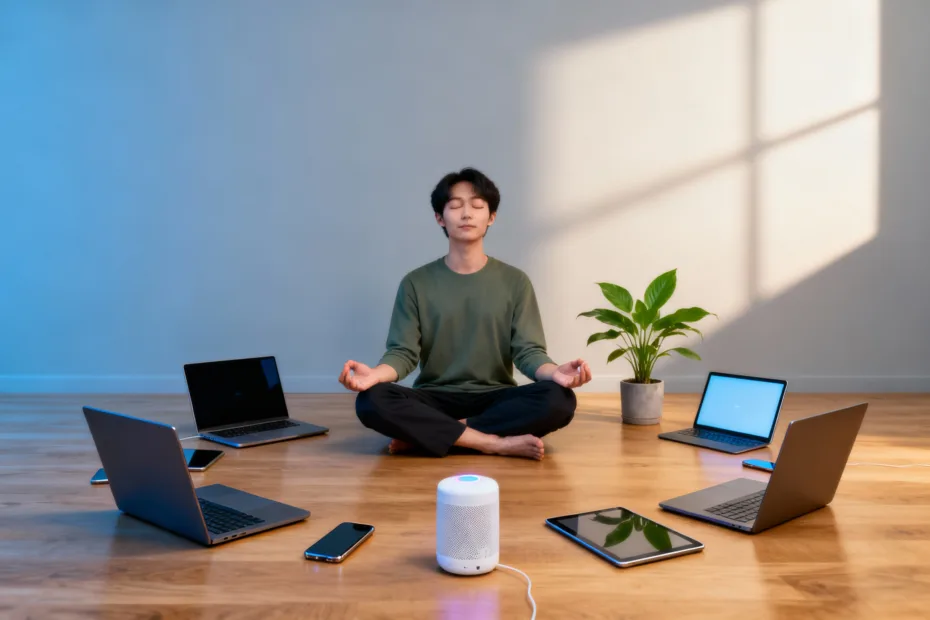
Your brain wants quiet, but your phone keeps screaming. You try to focus, and suddenly you’re in three group chats, two inboxes, and a rabbit hole about refrigerators. The good news? You can build a calm mind without running off to a cabin in the woods. You just need a few smart habits and some friendly boundaries—yes, even with your phone.
Decide What You’re Here For
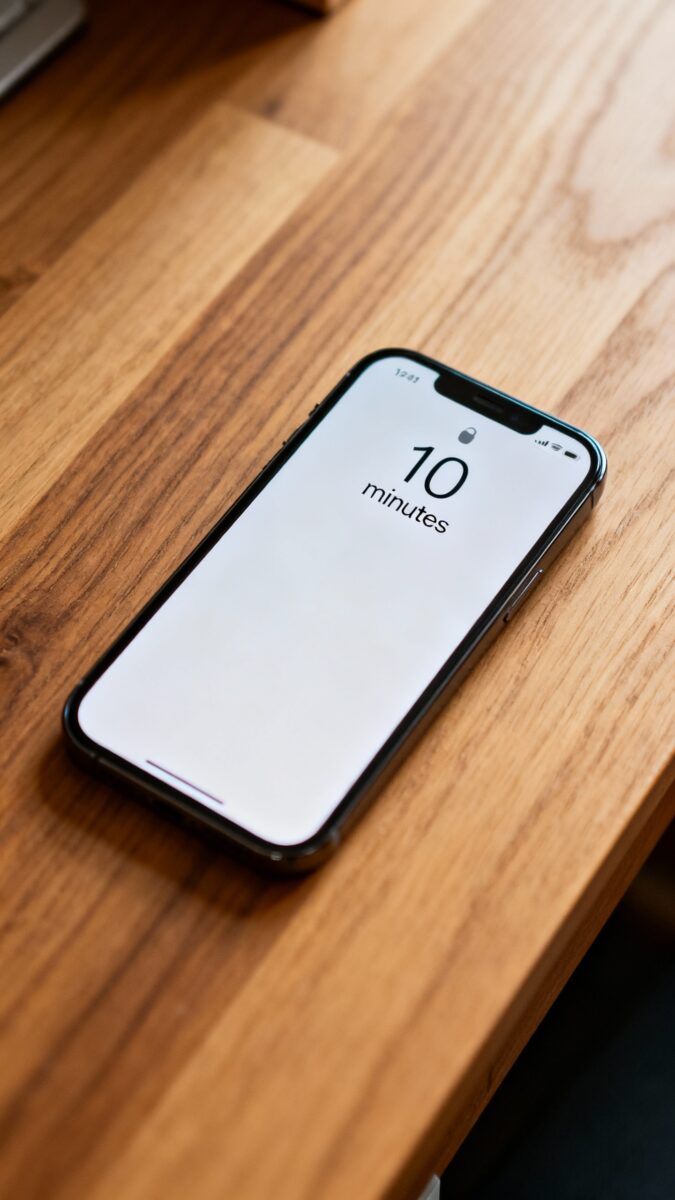
Your mind gets noisy when your intentions get fuzzy. Before you open an app, ask: what am I doing here? If you don’t set a purpose, the algorithm will happily set one for you.
- State your goal before you start: “I’m checking messages for 5 minutes,” or “I’m researching microphones.”
- Use timer sprints: 10–25 minutes of intentional screen time, then step away.
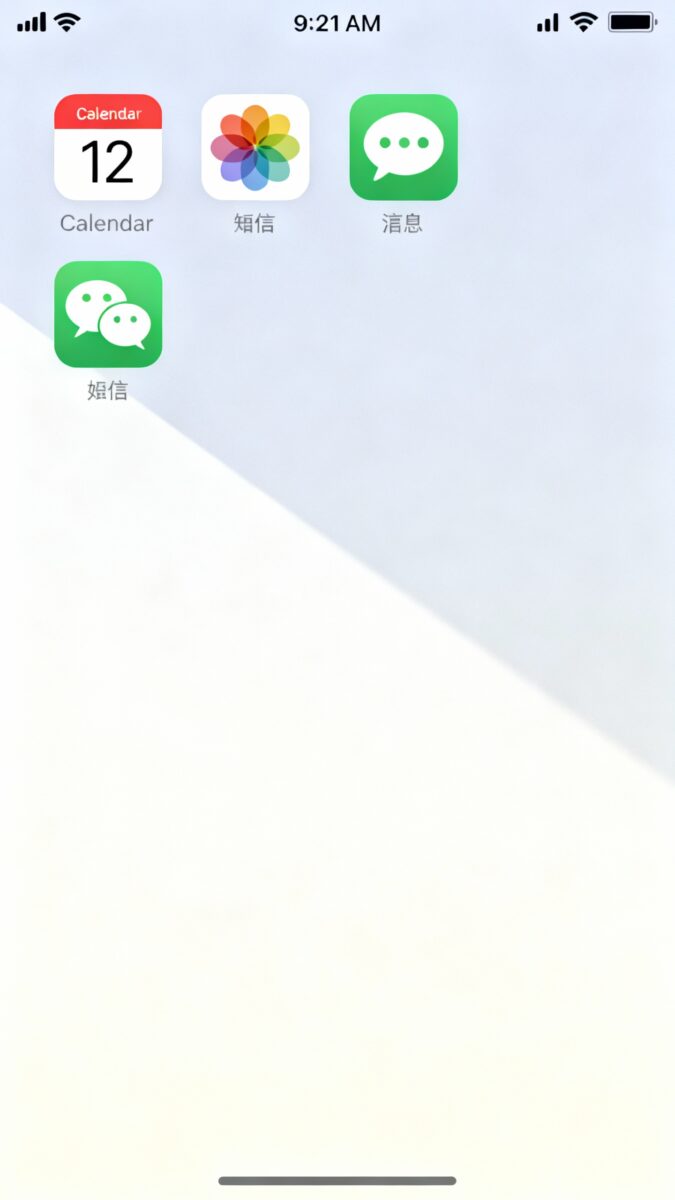
- Reduce entry points: remove shortcuts from your home screen for apps that hijack your attention.
Make your phone boring on purpose
This sounds mean, but your phone doesn’t need to be fun. Put time-wasters in a folder called “Later.” Switch your display to grayscale if you really want extra calm. FYI: duller screens equal duller cravings.
Guard Your Inputs Like a DJ
You can’t control the internet, but you can control your lineup. Your brain processes digital noise like junk food—fast, cheap, and not super fulfilling. So curate.
- Mute and unfollow generously. You owe no one your attention. Not even that “inspo” account that secretly stresses you out.
- Batch your news. Pick one or two reliable sources and check them at set times.
- Set quiet hours. Use Do Not Disturb in the evenings and mornings. The world survives, promise.
Upgrade your notifications strategy
Turn off badges and alerts for everything except calls and messages from your real-life humans. The red dots hack your brain. IMO, they’re the Vegas of UI.
Build Micro-Rituals That Reset Your Brain

You don’t need a 60-minute meditation to feel human again. Small, repeated rituals act like mental hand-washing between tasks.
- Box breathing (4-4-4-4): inhale, hold, exhale, hold. Repeat 4 times before opening a new app.
- Single-sentence journaling: “Right now I’m working on X, and I feel Y.” Clarity in 10 seconds.
- Two-minute tidy: clear your desk, close tabs, hydrate. Calm follows order.
The one-tab rule
Keep one browser tab visible. Park reference tabs in a reading list. You remove decision fatigue and stop digital whiplash. Bonus: your laptop fan stops screaming like it’s about to take flight.
Design Your Environment for Calm

Your surroundings can either whisper “focus” or yell “chaos.” Tweak the space so calm feels inevitable.
- Make a focus zone: a chair, a lamp, headphones. When you sit there, your brain knows it’s go time.
- Use sound with intent: brown noise, lo-fi beats, or nature sounds. Not podcasts. Your brain will try to follow the story.
- Separate devices if you can: tablet for reading, laptop for work, phone for communication. Less cross-contamination, more peace.
Lighting matters more than you think
Warm light in the evening = calm mind. Cold light during the day = alert mind. You don’t need a fancy setup—just a lamp you actually turn on.
Master Your Attention Like a Skill
Calm doesn’t appear by magic. You train it. And no, you don’t have to become a monk.
- Practice monotasking: pick one thing and set a visible timer. When your brain wanders, note it and return. That’s the rep.
- Use friction wisely: sign out of distracting apps. Add a browser extension that blocks specific sites for a few hours.
- Schedule scroll time: 15 minutes guilt-free in the afternoon. Want to scroll more? Wait for the next window.
When your mind overloads mid-task
Try a 3-step reset:
- Stand up and drink water.
- Write your next tiny step on a sticky note.
- Do only that step. Then reassess.
It’s like rebooting your brain without the spinning wheel.
Nourish the Hardware (Yes, Your Brain)
You can’t out-hack biology. If your brain runs on fumes, every notification feels urgent.
- Protect sleep like a dragon guards treasure. Dim screens early, wear blue-light glasses if needed, and stop doom-scrolling in bed.
- Feed your focus: protein, fiber, water, magnesium-rich foods. Coffee helps—until it doesn’t. Time it before noon if sleep gets wonky.
- Move daily: 10-minute walks reset stress chemistry better than another “productivity tip.”
Digital sunset routine
Pick a nightly wind-down:
- Close all tabs.
- Write tomorrow’s top 3 tasks.
- Put your phone on a charger outside your bedroom.
Boring? Yes. Effective? Also yes.
Choose What You’ll Ignore
Calm isn’t just what you do—it’s what you skip. Decide now what doesn’t deserve your attention.
- Ignore the urgency theater: if everything’s labeled “ASAP,” nothing is.
- Opt out of arguments you can’t win (especially online). Your sanity beats scoring points with strangers.
- Let some messages wait. You can set response windows and tell people: “I check DMs at 1 pm and 5 pm.” Boundaries are not rudeness.
Say no with kindness
Try: “Thanks for thinking of me. I can’t give this the attention it deserves right now.” You protect your focus and your relationships. Win-win.
FAQ
How do I calm my mind fast when I feel overwhelmed?
Step away from screens for two minutes. Do box breathing, splash cold water on your face, then write your next single action on paper. The combo of physical reset and clarity shrinks the mental noise quickly.
What if my job requires constant online presence?
Build micro-borders. Use status messages, batch checks at predictable times, and keep high-notice channels (like Slack) visible only during work blocks. Outside those blocks, set Do Not Disturb and delegate emergencies to one channel only.
Do I need to quit social media to feel calm?
Nope. You need intention and limits. Curate who you follow, mute aggressively, and schedule your scrolls. If a platform consistently ruins your mood, take a two-week break and reassess. IMO, you’ll learn exactly what you miss—and what you don’t.
Which apps actually help with calm?
Keep it simple: a focus timer, a good notes app, and a site blocker. Optional: a sound generator for brown noise. Tools that remove friction work better than shiny ones that add more steps.
How do I stop checking my phone at night?
Create barriers. Charge it outside your bedroom, use an old-school alarm clock, and enable a downtime mode after a set hour. Add a tiny reward—book, tea, playlist—so your brain associates night with ease, not FOMO.
What if I try all this and still feel scattered?
Start smaller. Pick one practice and nail it for a week, like one-tab browsing or a nightly digital sunset. If anxiety or focus issues persist, talk to a professional. Your nervous system might need more support than lifestyle tweaks can offer—totally normal.
Conclusion
You can’t mute the entire internet, but you can create calm on your side of the screen. Set intentions, curate inputs, and build tiny rituals that reset your brain on demand. Protect your attention like it’s priceless—because it is. And if you stumble? No worries. Close a tab, take a breath, and start your next tiny step. FYI: that’s what progress looks like.
EXPLORE MORE ON VIBE FOR CREATORS
Learn how to build sustainable income streams and grow with intention inside DIGITAL BUSINESS & INCOME .
Discover tools, platforms, and workflows that support your creative journey in CREATOR TOOLS & RESOURCES .
Discover how artificial intelligence is transforming the creator economy inside AI FOR CREATORS .
Explore powerful tools that help digital creators write, design, and grow faster in AI TOOLS FOR CREATORS .
Learn how to create virtual influencers, digital avatars, and AI-powered creator brands in AI AVATARS & VIRTUAL CREATORS .
Master Pinterest strategy, content creation, and long-term visibility with insights from PINTEREST & CONTENT STRATEGY .
Learn authentic marketing, branding, and audience connection inside MARKETING & BRAND TRUTHS .
Strengthen your confidence, clarity, and inner alignment through PERSONAL GROWTH & MINDSET .
Explore mindset shifts, creator confidence, and intentional growth in CREATOR MINDSET .
Download helpful resources, guides, and tools designed to support your journey in FREEBIES & PRINTABLES .