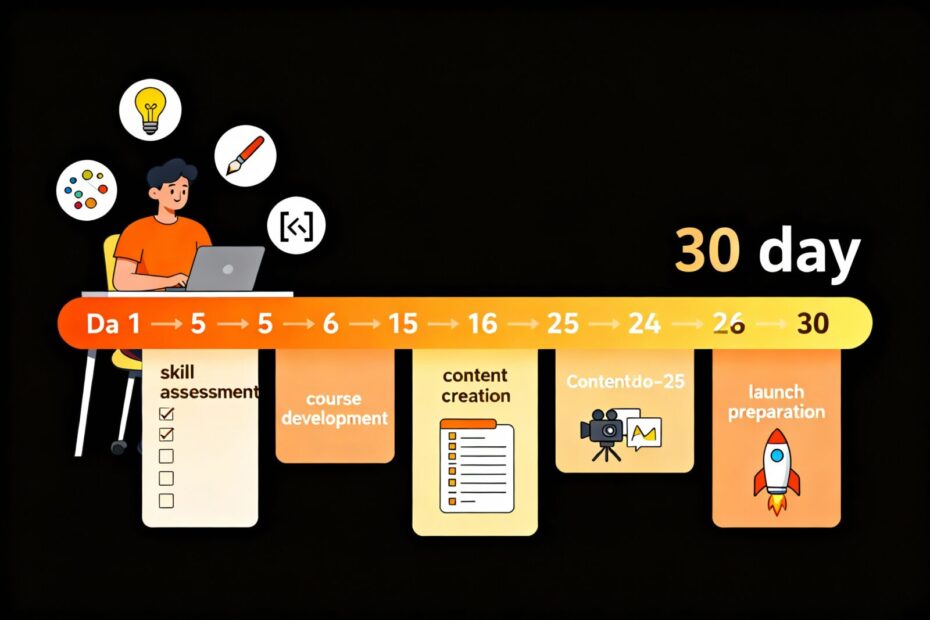
You’ve got skills people would pay to learn. The only problem? You’re not sure how to package them into a course without vanishing into a 6-month planning spiral.
Let’s skip the spiral. In 30 days, you can build a lean, profitable online course that sells while you sleep (or at least naps while you sip coffee). Sound bold?
Good. Let’s get scrappy and make it happen.
Pick a Small, Profitable Problem (Day 1–3)

You don’t need to teach everything you know. You need to solve one painful problem for one specific person.
Think “Beginner iPhone Photography in 14 Days,” not “Master Photography Forever.” Specific wins every time. How do you pick the topic?
- List 5–10 skills people ask you about. If friends DM you for help with it, that’s a clue.
- Brainstorm outcomes people want fast: “Launch a simple website,” “Get a remote job-ready resume,” “Bake sourdough that doesn’t look sad.”
- Validate demand with quick searches on Reddit, YouTube, and course platforms. Look for repeat questions and paid products.
Use this simple filter:
- Clear audience: “freelance designers,” “new parents,” “entry-level marketers.”
- Defined outcome in 2–4 weeks.
- Low competition or a fresh angle (faster, cheaper, niche, or more fun).
Quick Validation Script
Post in 2–3 relevant communities: “Thinking of making a [specific outcome] mini-course for [audience].
It would help you get [result] in [time]. Would you want this? What’s your biggest struggle?” If you get 10+ solid replies in 48 hours, green light.
Design the Outcome and Outline (Day 4–6)
Your course should promise one transformation.
Not 12. One. Then build a path to that transformation in 4–6 short modules. Define the transformation:
- From: “Confused about using Canva”
- To: “Confidently design social posts that get engagement in 30 minutes or less”
Map your modules:
- Kickoff: set expectations and tools
- Foundations: the 20% that gets 80% of results
- Core skills: step-by-step tutorials
- Project: apply skills to a real scenario
- Common mistakes + troubleshooting
- Next steps: maintain results and level up
Keep lessons short: 5–10 minutes each. Short lessons increase completion rates and reduce your recording anxiety.
Also, add a simple worksheet or checklist per module to boost perceived value with minimal effort.
Your One-Sentence Sales Promise
“I help [audience] get [specific result] in [timeframe] without [dreaded thing they hate].” Example: “I help beginner creators design scroll-stopping Instagram posts in 14 days without complicated software.”

Pre-Sell Like a Pro (Day 7–12)
Before you build, sell it. Yes, really. You’ll avoid making a beautiful course nobody asked for.
Pre-selling also funds your coffee and tools. Craft a lightweight landing page with:
- Clear promise and who it’s for
- 3–5 bullet-point outcomes
- What’s included (modules, templates, community)
- Bonuses for early buyers
- Start date and delivery plan (live cohort or drip content)
- Founding-member price and guarantee
Pricing, IMO:
- Mini-course (1–2 hours): $49–$149
- Signature starter (4–6 hours): $199–$399
- Cohort-based/live support: add $100–$300
Traffic in 72 Hours
- Email your list (even if it’s tiny). Ask for replies with questions. Replies validate demand and give you copy.
- Post 3–5 short tips on social that lead to your landing page.
- DM warm leads you’ve helped before: “FYI I’m launching a small course on X. Want details?”
- Offer 10 founding seats at a discount.
Cap it. Scarcity helps, but don’t be weird about it.
Goal: 5–15 pre-orders. If you don’t get them, adjust the promise or audience and try again for three more days.
Build the Course Fast Without Burning Out (Day 13–22)
Build the minimum viable version and launch it.
You can always improve later with student feedback. Perfection is cute but broke. Your tool stack (keep it simple):
- Recording: Loom, ScreenFlow, or OBS
- Slides: Google Slides or Canva
- Hosting: Teachable, Thinkific, Podia, or Gumroad
- Community: Circle, Skool, or a private Discord
- Payments: Stripe or built-in platform checkout
Recording checklist:
- Good mic beats fancy camera. Use a USB mic or wired earbuds.
- Natural light in front of you, not behind you.
Instant upgrade.
- Script bullets, not essays. Teach like you’re on a video call with a friend.
- Record in batches: all Module 1 videos, then Module 2, etc.
Keep Content Tight
- Each lesson solves one micro-problem.
- Show your screen. People learn by seeing, not by hearing motivational monologues.
- Add a quick action: “Do this now.”
- Upload a PDF checklist or template. Templates sell courses.
Deliver an Amazing First Experience (Day 23–26)
Your early students are your growth engine.
Wow them, and they refer friends. Ignore them, and you’ll argue with your cat about conversion rates. Kickoff call (live or recorded):
- Set ground rules: what to expect, how to ask for help, how to get results.
- Share the roadmap and weekly targets.
- Invite them to post wins. Momentum breeds momentum.
Support system:
- Weekly office hours or Q&A thread
- Accountability check-ins: “What will you complete by Friday?”
- Fast feedback within 24–48 hours (FYI, even a quick Loom reply works wonders)
Collect Proof as You Go
Ask for progress screenshots, before-and-after examples, and short testimonials.
Offer a small reward: “Post your first project and I’ll review it personally.” You’ll get social proof, and they’ll get results. Win-win.
Optimize, Upsell, and Automate (Day 27–30)
Now polish. You’ve delivered value.
Time to scale without cloning yourself. Improve quickly:
- Watch where students get stuck. Re-record those lessons shorter and clearer.
- Turn common questions into bonus videos.
- Bundle your best templates and checklists as a “Pro Kit.”
Automate the funnel:
- Lead magnet: a 10-minute mini-workshop or a template pack.
- Email sequence: 5–7 emails that teach, build trust, and pitch the course.
- Evergreen webinar or workshop replay with a limited-time bonus.
Introduce the next step:
- Upsell a coaching call or a premium cohort.
- Create a membership for ongoing support and updates.
- Add a referral program with 20–30% commissions. Affiliates love clarity and assets.
Marketing That Doesn’t Feel Cringe
If selling makes you itchy, focus on helping in public.
Teach small bits where your audience hangs out and invite them into the deeper, structured version (aka your course). Content ideas that convert:
- “Common mistakes” posts that show you understand the struggle
- Short before/after demos
- Student wins and case studies (with permission)
- Compare tools and workflows, then link to your relevant module
Where to share, IMO:
- Newsletter: the most underrated long game
- LinkedIn for pros, Instagram/TikTok for visual skills, Twitter/X for hot takes
- Podcasts as a guest: instant trust transfer
Copy Basics That Sell
- Lead with outcomes, not features.
- Speak to one person. “If you’re a [role], this will help you [result].”
- Use numbers and timeframes. Vague = invisible.
- Add urgency with honest timelines: “Cohort starts Monday,” not fake countdowns.
Simple Tech Setup (No Overwhelm)
Let’s keep the tech drama low. You don’t need an enterprise stack.
You need stable tools you can use today. Minimum viable setup:
- Checkout: platform-native checkout or Stripe link
- Delivery: course platform with drip lessons
- Email: ConvertKit, Beehiiv, or MailerLite
- Community: private group with notifications on
Nice-to-have later:
- Zapier automations (enroll -> send welcome email -> add to community)
- Analytics dashboards for completion and revenue
- Affiliate tracking via your platform or Rewardful
FAQ
How much content do I actually need?
Aim for 60–120 minutes of focused lessons for a starter course. Break it into 8–15 short videos and add templates or checklists. Students want outcomes, not a Netflix season.
Keep it lean and potent.
What if I don’t have an audience?
Borrow one. Partner with creators, appear on niche podcasts, post value-packed threads in relevant communities, and run a small paid ad to a lead magnet. A tiny, engaged list beats a big silent one.
Should I do live or pre-recorded?
If you’re new, run the first cohort live.
You’ll teach better, learn faster, and gather proof. Record those sessions, edit them lightly, and that becomes your evergreen course. Efficient and effective.
What if I’m not “expert” enough?
You don’t need 10,000 hours.
You need to be a few steps ahead with a repeatable process. Teach what you’ve done successfully. Be honest about your scope.
Students love clarity over ego.
How do I price it without guessing?
Price based on transformation and speed. If your course saves time, earns money, or reduces big pain, price higher. Start at a fair founding rate, then raise it with each cohort as results roll in.
FYI: discounts should reward early action, not your fear.
Do I need fancy production?
Nope. Clear audio and tight content beat cinematic vibes. Use a decent mic, good lighting, and clean slides.
People buy outcomes, not lens flares.
Conclusion
You can ship a profitable course in 30 days if you keep it tight and focused. Choose a small, painful problem, pre-sell it, build the minimum that delivers results, and support students well. Then iterate, automate, and scale.
The hardest part? Starting. The second hardest part?
Not overcomplicating it. You’ve got this—now go turn your skills into something people happily pay for.
EXPLORE MORE ON VIBE FOR CREATORS
Learn how to build sustainable income streams and grow with intention inside DIGITAL BUSINESS & INCOME .
Discover tools, platforms, and workflows that support your creative journey in CREATOR TOOLS & RESOURCES .
Discover how artificial intelligence is transforming the creator economy inside AI FOR CREATORS .
Explore powerful tools that help digital creators write, design, and grow faster in AI TOOLS FOR CREATORS .
Learn how to create virtual influencers, digital avatars, and AI-powered creator brands in AI AVATARS & VIRTUAL CREATORS .
Master Pinterest strategy, content creation, and long-term visibility with insights from PINTEREST & CONTENT STRATEGY .
Learn authentic marketing, branding, and audience connection inside MARKETING & BRAND TRUTHS .
Strengthen your confidence, clarity, and inner alignment through PERSONAL GROWTH & MINDSET .
Explore mindset shifts, creator confidence, and intentional growth in CREATOR MINDSET .
Download helpful resources, guides, and tools designed to support your journey in FREEBIES & PRINTABLES .