
Introduction: Why Motivation Alone Isn’t Enough
Every creator knows the feeling—some days you wake up inspired, ready to build, design, or write. But then there are those days when motivation disappears, leaving you stuck, frustrated, and overwhelmed.
That’s when discipline over motivation becomes your greatest ally.
Motivation is emotional—it’s the spark that gets you started. But discipline is structural—it’s the system that keeps you moving forward when inspiration fades. True creators don’t rely on feelings; they rely on frameworks, routines, and the power of consistency.
In this article, you’ll discover the science behind discipline, how it rewires your creative brain, and the exact habits that help you stay consistent even when you feel burned out.
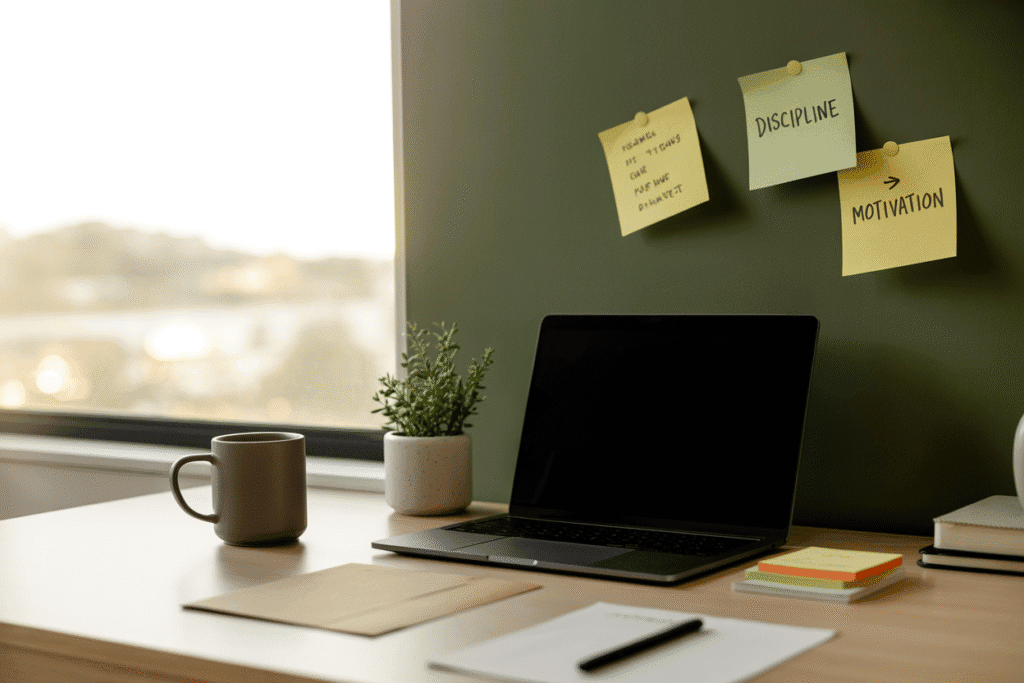
What Does “Discipline Over Motivation” Really Mean?
The phrase isn’t about rejecting motivation—it’s about prioritizing control over emotion. Discipline means doing what matters most, even when you don’t feel like it.
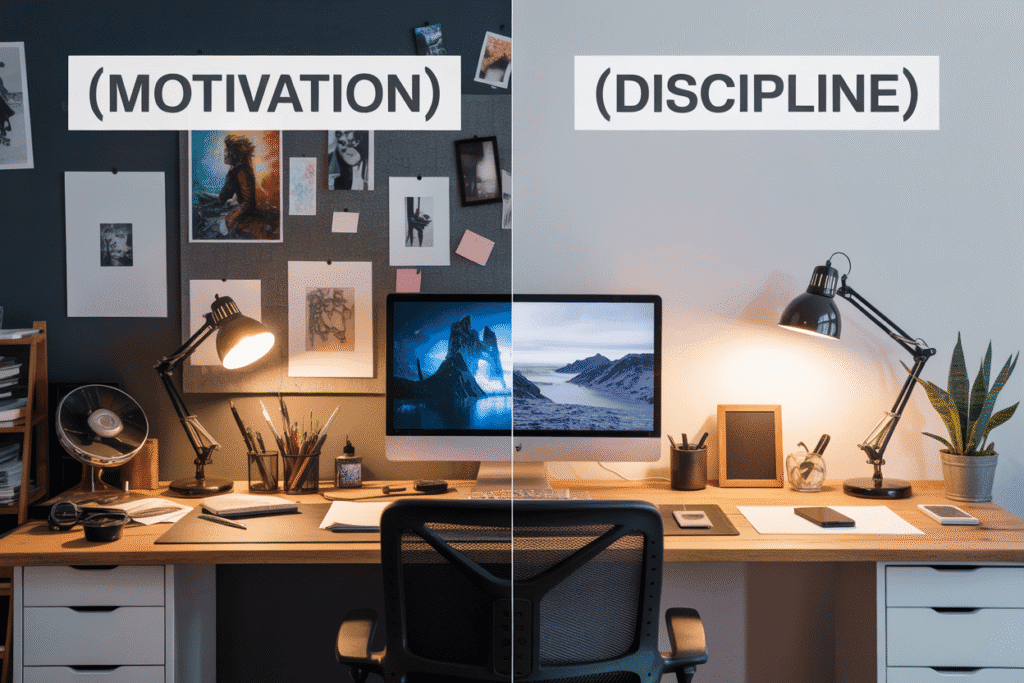
| Motivation | Discipline |
|---|---|
| Emotional and temporary | Rational and consistent |
| Depends on mood | Depends on commitment |
| External drive | Internal structure |
| Inspires action | Sustains action |
A disciplined creator doesn’t wait for the right mood. They create the right conditions to take action, every single day.
The Psychology of Discipline: Why It Always Wins
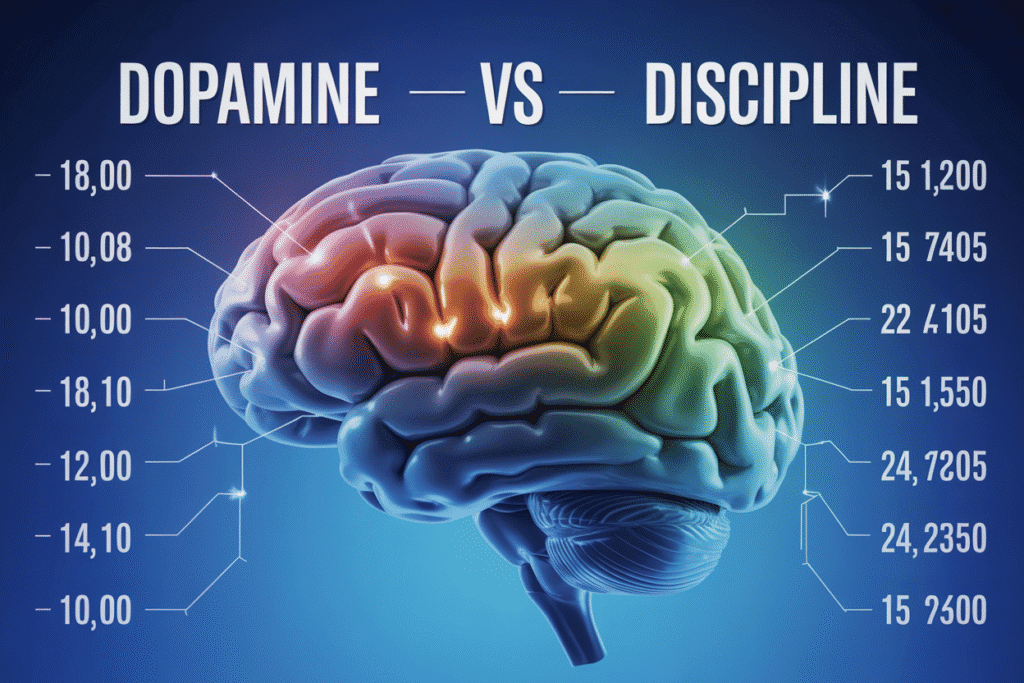
Science proves it—discipline activates the prefrontal cortex, the part of the brain responsible for planning, decision-making, and focus. Motivation, however, is driven by dopamine, which fluctuates constantly.
When you rely only on dopamine spikes, your productivity crashes as soon as the excitement fades. Discipline builds a stable neural pathway for focus and resilience. It transforms creativity from chaos into consistency.
My Personal Creator Mindset Shift
There was a time when I’d wait for inspiration to strike before writing or filming. Days turned into weeks, and projects stayed half-finished. Everything changed when I committed to showing up daily, no matter how I felt.
After two weeks of steady action, my output doubled. After a month, I had built a routine that no longer depended on motivation.
Discipline gave me freedom from inconsistency.
Freedom from guilt.
Freedom from creative paralysis.

How to Build Discipline in Your Creative Routine
1. Start Small — Build Micro Habits
Don’t aim for 3 hours a day right away. Start with 15 minutes of focused work. Gradually extend your sessions. The key is to make it impossible to fail.
2. Design Your Environment for Success
Remove friction. Keep your tools ready. Have a dedicated creative corner. When your space signals “it’s time to create,” your brain follows.
3. Track Progress, Not Perfection
Journals and habit trackers keep you accountable. Remember, perfection kills progress. Focus on consistency instead of flawless output.

When Burnout Hits: Staying Consistent in Low-Energy Phases
Every creator faces burnout. It doesn’t mean you’ve failed—it means you’ve grown tired of pushing without balance. Discipline helps you push with awareness, not force.
Show Up Imperfectly
On low-energy days, doing something small—writing one paragraph, editing one clip—still counts. Consistency is built on repetition, not intensity.
Use Rest Strategically
Discipline doesn’t mean overworking; it means knowing when to pause. Scheduled rest prevents emotional exhaustion.
Reconnect with Your “Why”
Remember why you started. When motivation fades, purpose keeps you grounded. Your “why” is your emotional anchor during creative fatigue.
The Creator’s Discipline Toolkit
Here are essential tools to help you stay consistent:
| Tool | Purpose |
|---|---|
| Time Blocking | Protect your focus time daily |
| Pomodoro Timer | Maintain short bursts of deep work |
| Accountability Partner | External check for consistency |
| Digital Detox | Reduces distraction and mental clutter |
| Vision Board | Keeps goals visible and tangible |
Use these systems to turn your daily workflow into a creative discipline machine.
How Top Creators Apply “Discipline Over Motivation”
YouTubers, writers, and entrepreneurs all share one pattern: they create on schedule.
Even when the spark isn’t there, they post, refine, and improve.
Creators like Ali Abdaal, Matt D’Avella, and Emma Chamberlain have admitted they rely on discipline, not constant inspiration. They build systems that make creativity automatic.
The Benefits of Discipline for Creators
- Predictable Productivity – You no longer rely on good days to make progress.
- Reduced Stress – Structure minimizes uncertainty and chaos.
- Improved Quality Over Time – Regular practice refines skills.
- Professional Mindset – You start treating creativity as a craft, not a hobby.
- Long-Term Fulfillment – Sustainable progress leads to confidence.
Common Mistakes When Building Discipline
- ❌ Expecting perfection from day one
- ❌ Setting unrealistic schedules
- ❌ Working without breaks
- ❌ Comparing your pace to others
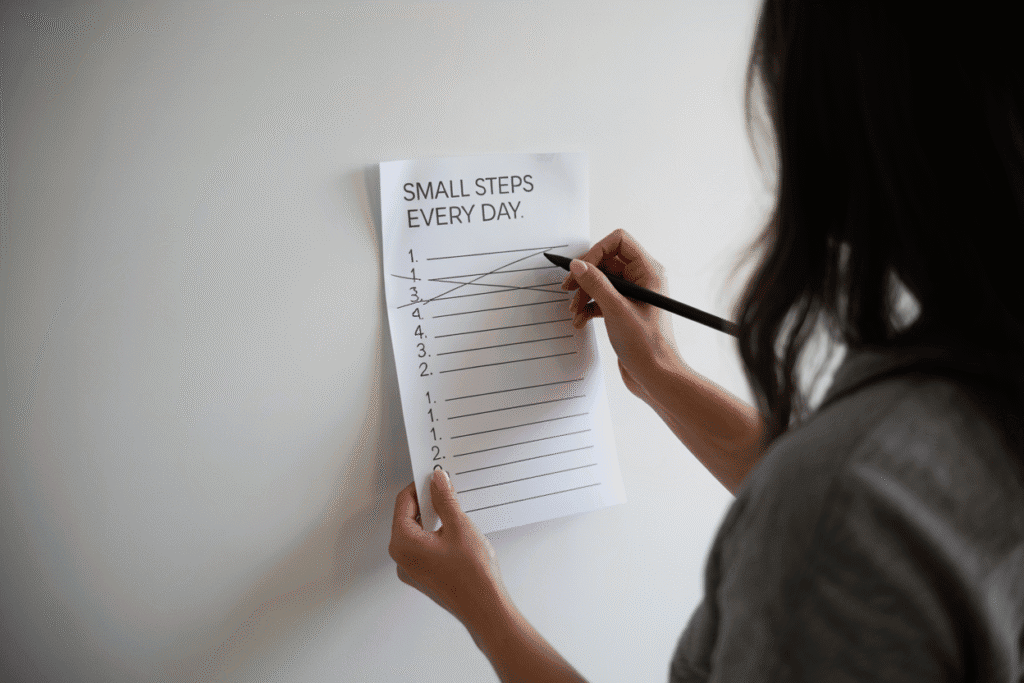
Instead, use the “1% rule” — improve a little every day. Small, consistent steps lead to massive creative transformation.
Do’s & Don’ts for Creators
| Do | Don’t |
|---|---|
| Set realistic daily goals | Wait for inspiration to strike |
| Create in distraction-free time | Work in chaos |
| Reflect weekly on progress | Criticize your slow growth |
| Use structure as support | View discipline as punishment |
Costs & Timeframe: Building Discipline as a Creator
Building strong discipline is free—but it costs time and patience.
Expect noticeable results within 30–45 days of consistent effort.
You’ll feel more focused after two weeks, and your creative identity will start to shift after the first month.
Whenever my motivation drops, I revisit my Manifestation Journal to realign with my purpose and visualize success — it’s a simple tool that keeps my creative energy focused.
FAQs About Discipline Over Motivation
1. What’s the main difference between discipline and motivation?
Motivation is emotional and temporary; discipline is structured and lasting. Discipline keeps you consistent even when you’re not inspired.
2. How can I stay consistent when I feel burnt out?
Lower the bar. Do something small, rest, and reconnect with your purpose.
3. Is discipline natural or learned?
It’s 100% learned. Anyone can develop it through repetition and structure.
4. How long does it take to build discipline?
Usually 30–45 days of consistent daily practice form new habits.
5. Can discipline kill creativity?
No. It creates the foundation where creativity thrives consistently.
6. What are good tools to strengthen discipline?
Habit trackers, accountability systems, time-blocking, and mindfulness.
Conclusion: Discipline Is Your Creative Superpower
Motivation will always come and go. But when you choose discipline, you gain control over your creative future.
Every post, design, or idea created from discipline builds confidence and momentum.
Your craft deserves consistency — not mood swings.
Start small. Show up daily.
Discipline is the bridge between your goals and your results.
EXPLORE MORE ON VIBE FOR CREATORS
Learn how to build sustainable income streams and grow with intention inside DIGITAL BUSINESS & INCOME .
Discover tools, platforms, and workflows that support your creative journey in CREATOR TOOLS & RESOURCES .
Discover how artificial intelligence is transforming the creator economy inside AI FOR CREATORS .
Explore powerful tools that help digital creators write, design, and grow faster in AI TOOLS FOR CREATORS .
Learn how to create virtual influencers, digital avatars, and AI-powered creator brands in AI AVATARS & VIRTUAL CREATORS .
Master Pinterest strategy, content creation, and long-term visibility with insights from PINTEREST & CONTENT STRATEGY .
Learn authentic marketing, branding, and audience connection inside MARKETING & BRAND TRUTHS .
Strengthen your confidence, clarity, and inner alignment through PERSONAL GROWTH & MINDSET .
Explore mindset shifts, creator confidence, and intentional growth in CREATOR MINDSET .
Download helpful resources, guides, and tools designed to support your journey in FREEBIES & PRINTABLES .