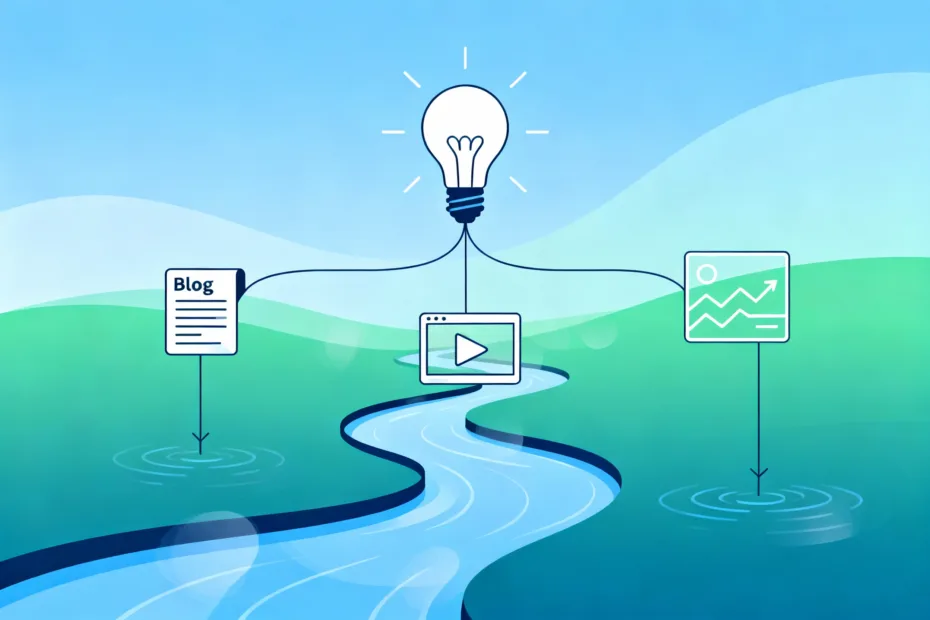
You don’t need 50 ideas to drive traffic. You need one good idea that refuses to die. Think of it like sourdough starter for your content—feed it right, and it’ll keep giving. You’ll save time, build authority, and create traffic that compounds. Sounds better than chasing trends, right?
Start with a “Core Idea” That Actually Matters
Your entire strategy starts with one meaty idea. Not a cute tip. Not a trending hack. A concept that solves a real problem and can stretch across formats.
How do you know you’ve got a core idea?
- People ask the same question over and over.
- It plugs into a broader problem (revenue, time, growth, peace of mind).
- You can explain it in 60 seconds or teach it for 60 minutes.
Now frame that idea in a way people care about. “Build a content engine” turns into “Turn one idea into 90 days of traffic.” Same concept, better hook.
Package It as a Flagship Piece
Start with one flagship asset:
- Long-form post or guide: SEO-friendly, linkable, evergreen.
- Webinar or workshop: Interactive and repurposable.
- Anchor video: YouTube loves depth and watch time.
Pick the format you can finish fast and distribute well. Don’t overengineer. Ship it.
Chop It Into Momentum: The Content Pyramid

You’ll turn your flagship into layers of smaller content. Think pyramid, not chaos.
- Core asset: The “definitive” piece.
- Primary derivatives: 5–10 standalone pieces (blog posts, videos, podcasts).
- Social snippets: 20–50 micro posts (quotes, carousels, threads).
- Atoms: 100+ comments, quick tips, replies, and email PS lines.
You don’t “create more.” You extract. You remix. You reframe. You keep the message identical—just change the angle and the format.
What to Extract First
From your flagship, pull:
- Definitions: What it is, what it isn’t.
- Frameworks: Steps, checklists, maps.
- Examples: Case studies, mistakes, wins.
- Objections: “But what if…” material.
Each one becomes a post, a clip, and a thread. Yes, all three. Efficient, not lazy.
Make SEO Your Silent Salesperson
Repurposing isn’t just spray-and-pray. You should build search traffic that quietly grows while you sleep.
Baseline SEO moves (IMO you only need these to start):
- One pillar page: Your flagship optimized for the main keyword (e.g., “content repurposing strategy”).
- Cluster posts: 5–8 posts targeting specific angles (e.g., “repurpose webinars,” “turn podcasts into blogs”). Link back to the pillar.
- Internal links: Every derivative links to the pillar and 1–2 siblings.
- Answer questions: Use FAQ schema. Answer clearly. Keep it human.
Update, Don’t Rewrite
Traffic compounds when you keep content fresh. Every 60–90 days:
- Add one new example or stat.
- Expand a weak section.
- Consolidate duplicate posts (canonical if needed).
That tiny maintenance loop beats rebuilding from scratch. FYI: Google loves steady updates.
Turn One Recording Into a Content Factory

Record a 30–60 minute session where you teach the idea. Audio or video. Doesn’t need studio lighting. Clarity beats fancy.
From one recording, create:
- 3–5 short vertical videos (hooks, myths, steps).
- 1 podcast episode (or guest spots using the same talking points).
- 1–2 blog posts from the transcript.
- 1 email sequence (tease → teach → invite).
- Slides for a webinar or carousel.
Simple Hook Templates
Use these on shorts, emails, and threads:
- “You’re wasting content if you’re not doing this…”
- “Repurpose vs. repost: here’s the difference.”
- “One idea → 30 posts: my exact workflow.”
Hooks sell the click. The core idea wins the trust.
Design a Weekly Repurposing Cadence
You don’t need a big team. You need a simple routine you can actually follow.
Weekly rhythm (adapt it to your life):
- Monday: Draft or update one pillar/cluster post. Pull 3 quotes.
- Tuesday: Record one 20–30 min session. Clip 3 shorts.
- Wednesday: Publish a blog + email. Post 2–3 social snippets.
- Thursday: Engage: comments, DMs, questions. Harvest content ideas from replies.
- Friday: Analyze top performers. Queue next week’s variations.
Repurpose Without Feeling Repetitive
Say the same thing five different ways:
- Story: A client win or your own failure.
- Data: A stat that backs your point.
- Framework: 3 steps, 5 mistakes, 7 signals.
- Analogy: “Sourdough starter for content.”
- Contrarian: “Stop posting daily. Repurpose weekly.”
Distribute Like You Mean It

Most people publish once, whisper “please go viral,” then move on. Don’t do that. Squeeze every channel you have.
Where to push your idea:
- Search: Blog + YouTube with optimized titles and chapters.
- Email: A main newsletter + 2 evergreen sequences (welcome and nurture).
- Social: One “home base” channel, two support channels.
- Communities: Niche forums, Slack groups, subreddits—share value, not spam.
- Partners: Guest posts, podcast swaps, co-webinars.
Golden rule: Don’t copy-paste. Adapt the opening 10 seconds (or first sentence) per platform. The scroll is brutal.
Measure What Actually Drives Long-Term Traffic
Not all metrics matter. Vanity numbers feel good. We want compounding traffic and leads.
Watch these:
- Search growth: Impressions and clicks to your pillar + cluster pages.
- Content-assisted conversions: Email signups or trials that touched your core idea.
- Repeat engagement: People who comment or return to similar posts.
- Backlinks: Natural links to your flagship. Update and pitch lightly.
If a derivative piece sends traffic, make three more versions with new intros and examples. If it tanks twice, move on. Data is feedback, not a personality test.
Common Pitfalls That Kill Momentum

Let’s dodge the landmines, yeah?
- Too many ideas: Pick one theme per quarter. Go deep, not wide.
- Inconsistent voice: Use one style guide and repeat your metaphors.
- Endless creation: If you’re not distributing, you’re journaling.
- Perfectionism: Good beats perfect. Perfect never ships.
- Copy-paste repurposing: Platform-native context matters. Threads aren’t carousels.
FAQ
How often should I create a new core idea?
Every 60–90 days is a sweet spot. That gives you time to build a content pyramid, see what resonates, and collect SEO data. When your traffic and engagement plateau, introduce the next core concept and repeat.
Can I repurpose old content that flopped?
Yes, but diagnose first. Did the hook fail? Was the example weak? Did you publish in the wrong channel? Fix the angle, add sharper proof, and repackage. Sometimes the idea is fine—your intro just snored.
What tools do I actually need?
Keep it simple: a doc editor, a scheduler, a transcript tool, and basic video editing. For SEO, a lightweight keyword tool is enough. IMO, workflows beat tools every time.
How do I avoid sounding repetitive?
Rotate formats (story, data, framework, analogy, contrarian) and update examples regularly. You’ll repeat the core message, but the wrappers change. Think touring musician: same songs, new city, fresh crowd.
Should I focus on one platform or many?
Start with one “home base” where you show up daily and two secondary channels you post to weekly. Once the system runs smoothly, expand. Spreading thin kills consistency and, ironically, traffic.
Is paid promotion worth it for repurposed content?
If a piece already performs organically, small paid boosts can multiply the reach. Promote winners, not hopes. FYI: retargeting people who visited your pillar content works wonders.
Wrap-Up: One Idea, Infinite Lifespan
You don’t need to reinvent yourself weekly. You need a core idea that earns its keep. Build a flagship, slice it into layers, optimize for search, and distribute with intent. Then do the unsexy part: update, repeat, and keep the hooks fresh. Do that for a quarter and watch your traffic curve tilt up—no hustle-porn required. IMO, that’s the kind of compounding effort worth bragging about.
EXPLORE MORE ON VIBE FOR CREATORS
Learn how to build sustainable income streams and grow with intention inside DIGITAL BUSINESS & INCOME .
Discover tools, platforms, and workflows that support your creative journey in CREATOR TOOLS & RESOURCES .
Discover how artificial intelligence is transforming the creator economy inside AI FOR CREATORS .
Explore powerful tools that help digital creators write, design, and grow faster in AI TOOLS FOR CREATORS .
Learn how to create virtual influencers, digital avatars, and AI-powered creator brands in AI AVATARS & VIRTUAL CREATORS .
Master Pinterest strategy, content creation, and long-term visibility with insights from PINTEREST & CONTENT STRATEGY .
Learn authentic marketing, branding, and audience connection inside MARKETING & BRAND TRUTHS .
Strengthen your confidence, clarity, and inner alignment through PERSONAL GROWTH & MINDSET .
Explore mindset shifts, creator confidence, and intentional growth in CREATOR MINDSET .
Download helpful resources, guides, and tools designed to support your journey in FREEBIES & PRINTABLES .