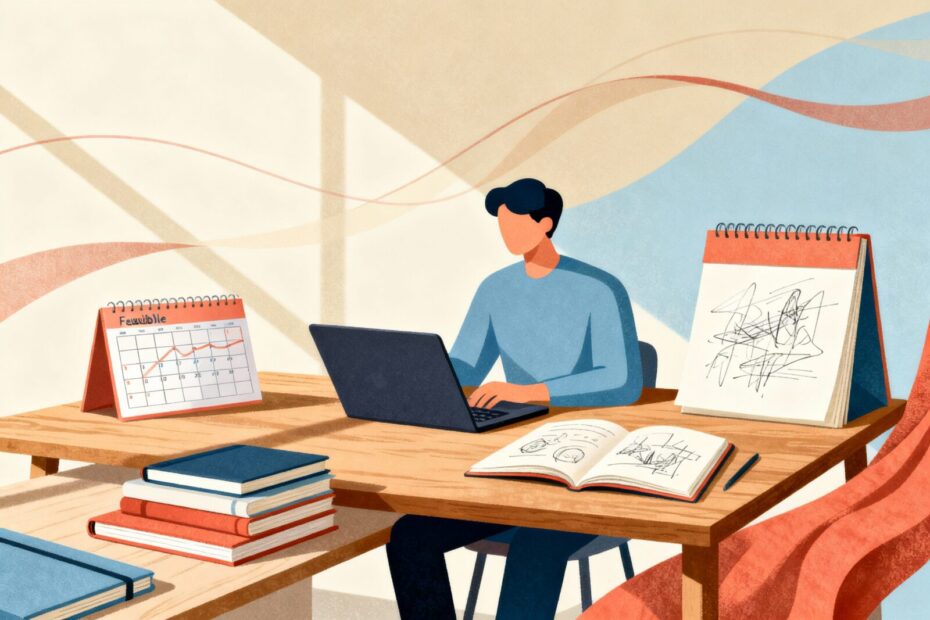
You want discipline without turning your creative life into boot camp? Same. You can build momentum, ship consistently, and still feel like a human with moods and whims.
The trick isn’t more rigidity—it’s better scaffolding. Think gentle guardrails, not handcuffs. Let’s build a creative engine you’ll actually want to run.
Redefine Discipline: Consistency Without the Cage
Discipline doesn’t mean waking up at 5 a.m., journaling for 47 minutes, and microdosing kale.
Discipline means you show up reliably and make meaningful progress. That’s it. Swap “I must do X every day at Y time” with “I move this project forward in ways that fit my energy.” You want a system that bends without breaking.
If you can’t bend, you’ll bail.
Make It Outcome-First
Instead of worshipping routines, worship outcomes. Pick a weekly output that matters:
- 1 short video published
- 2 newsletter segments drafted
- 3 illustrations sketched
Let the how and when flex. Keep the what sacred.
Design “Flexible Slots” Instead of Fixed Schedules
Routines feel rigid when every minute gets labeled.
So don’t label minutes—label slots. Slots are windows where you can choose one of a few pre-decided actions. Create 2-3 daily slots that fit your life.
Maybe a 30-minute morning slot, a 45-minute lunch slot, and a 60-minute evening slot. No exact time, just the next available window.
Use Choice Menus
Give each slot a tiny menu to reduce decision fatigue:
- Idea slot: brainstorm 10 titles, swipe-file 5 examples, outline 1 piece
- Production slot: record 1 take, draft 300 words, design 1 slide
- Polish slot: edit a paragraph, color-correct 2 images, write captions
You still choose, but within a sandbox. No rigid routine.
Just pathways.
Build a Two-Speed Creative System
Your brain has “deep work” days and “gremlin brain” days. Both count. You just need different gears.
- High-gear days (focus available): long stretches, hard problems, batch creation.
Outline a whole series. Record multiple takes. Edit aggressively.
- Low-gear days (life chaos): micro-tasks that compound.
Title brainstorming, file organization, B-roll capture, idea threads, quick edits.
Label your day honestly, then match tasks to the gear. No guilt. You’re still moving, just at a speed that fits.
Micro-Commitments That Don’t Break
When your day implodes, set a 10-minute minimum.
Choose a thing you can always do:
- Write 100 words
- Draft 3 hooks
- Clip 15 seconds of video
Minimums keep the streak alive without turning your life into a streak prison. IMO, the best discipline looks like this.
Externalize Your Brain: Reduce Friction, Increase Flow
Creative block often equals friction, not failure. Take the decisions out of your head and put them in your system.
- Idea capture everywhere: Notes app, voice notes, a paper pad.
If it holds an idea, it’s sacred.
- Template everything: project checklists, thumbnail layouts, intro scripts, caption formulas.
- One-tap start: a folder named “Start Here” with your current project assets ready.
If opening your laptop already places you in the middle of your project, congrats—you just stole back 20 minutes of anxiety.
Create a Swipe File That Actually Gets Used
Don’t hoard inspiration you never see. Make one dedicated spot for examples:
- One Notion page or a single folder with subfolders: Hooks, Visuals, Structures, Headlines
- Tag content by mood or theme: Calm, Spicy, Data-driven, Story
- Review it for 5 minutes before a production slot
You’ll start faster because you already primed your brain.
Gamify Progress, Not Perfection
You don’t need more pressure. You need more feedback.
Tiny wins keep you coming back.
- Visual trackers: a calendar with stickers, a progress bar, a habit app with a weekly view
- Weekly scorecard: Did I publish? Did I learn? Did I test something new?
- Experiment quota: 1 new format or hook per week—no expectations, just data
Publishing regularly beats “perfect but never shipped.” If you win the week, you win the year.
FYI, perfection melts under consistent output.
Use “Good, Better, Best” Standards
Define three levels so you can ship even on messy weeks:
- Good: publish a rough cut with captions
- Better: add hooks, B-roll, and a CTA
- Best: polish sound/design, test two thumbnails, A/B the title
You’ll avoid the all-or-nothing spiral that kills momentum.
Protect Your Energy Like It’s Part of the Job (Because It Is)
Creators don’t run on coffee alone. They run on attention, courage, and sleep. Treat energy as an input you manage.
- Match tasks to your energy curve: If you think best at night, record then.
If mornings slap, write then.
- Stop aimless scrolling: Make your home screen boring. Move socials to a folder called “Pay Rent.” It’ll remind you: post, don’t graze.
- Build transition rituals: a song, a beverage, a walk. Cue your brain that creation mode is on.
You’re not a robot.
You’re a rhythm. Respect that, and the work will respect you back.
Make Accountability Lightweight and Fun
Accountability doesn’t need to mean public shame or aggressive Slack messages. Keep it light.
- Buddy system: DM a creator friend your weekly output goal.
Report back Friday.
- Public micro-promises: “Publishing one thing this week.” No dates, no drama, just momentum.
- Office hours: set a recurring time when you go live or sit in a cowork stream. People show up; you ship.
Accountability should feel like a friend waiting at the gym, not a drill sergeant. IMO, that vibe change is everything.
When You Fall Off, Re-Enter Without Drama
You’ll miss days.
Maybe weeks. Don’t make it a personality trait. Make it a detour.
- Run a reset: prune projects, pick one flagship, archive the rest for now.
- Restart tiny: 10-minute slots for three days.
Then build.
- Debrief quickly: what blocked you—energy, tools, fear, expectations? Fix one thing.
No penance required. Just return and move forward.
FAQ
How do I stay consistent if my schedule changes constantly?
Use flexible slots instead of fixed times.
Define two or three windows you usually get (morning, midday, evening) and attach choice menus to them. If you miss a window, you take the next one. You protect the slot pattern, not the exact timing.
What if I never feel “inspired” when it’s time to work?
Prime yourself with a 5-minute ritual: open your swipe file, read 3 hooks, and set a tiny target like “write 100 words.” Inspiration doesn’t start the engine; action does.
You can always switch tasks mid-slot if the first one feels sticky.
Should I niche down or keep it broad while building discipline?
Start with a content spine—one core topic or format you can repeat weekly—and allow playful side pieces as bonuses. The spine builds identity and muscle memory; the extras keep you curious. Over time, double down on what earns engagement and joy.
How do I avoid burnout without losing momentum?
Alternate high-gear creation days with low-gear maintenance days.
Use “good, better, best” standards so you can ship even when tired. Also, set a weekly stop time—your future self will thank you. Rest isn’t a reward; it’s a requirement.
What metrics should I track without obsessing?
Track output (published pieces), learning (experiments run), and signals (saves, replies, watch time).
Check once a week, not hourly. The algorithm rewards consistency; your brain rewards clarity.
How do I handle perfectionism when I hate releasing imperfect work?
Time-box final touches and ship at “Better.” Save “Best” for cornerstone pieces. Your audience prefers steady, improving work over rare masterpieces.
Plus, feedback from “Better” upgrades the next thing faster than polishing alone.
Conclusion
You don’t need a rigid routine to be a disciplined creator. You need gentle guardrails, flexible slots, and a system that adapts to your energy. Protect output over optics, build a two-speed workflow, and let tiny wins stack.
Do that, and your creative life stops feeling like a cage and starts running like a flywheel. FYI: progress loves a playful plan.
EXPLORE MORE ON VIBE FOR CREATORS
Learn how to build sustainable income streams and grow with intention inside DIGITAL BUSINESS & INCOME .
Discover tools, platforms, and workflows that support your creative journey in CREATOR TOOLS & RESOURCES .
Discover how artificial intelligence is transforming the creator economy inside AI FOR CREATORS .
Explore powerful tools that help digital creators write, design, and grow faster in AI TOOLS FOR CREATORS .
Learn how to create virtual influencers, digital avatars, and AI-powered creator brands in AI AVATARS & VIRTUAL CREATORS .
Master Pinterest strategy, content creation, and long-term visibility with insights from PINTEREST & CONTENT STRATEGY .
Learn authentic marketing, branding, and audience connection inside MARKETING & BRAND TRUTHS .
Strengthen your confidence, clarity, and inner alignment through PERSONAL GROWTH & MINDSET .
Explore mindset shifts, creator confidence, and intentional growth in CREATOR MINDSET .
Download helpful resources, guides, and tools designed to support your journey in FREEBIES & PRINTABLES .